For the past two years, the AI conversation has focused on one question:
Who has the best model?
Increasingly, that may be the wrong question.
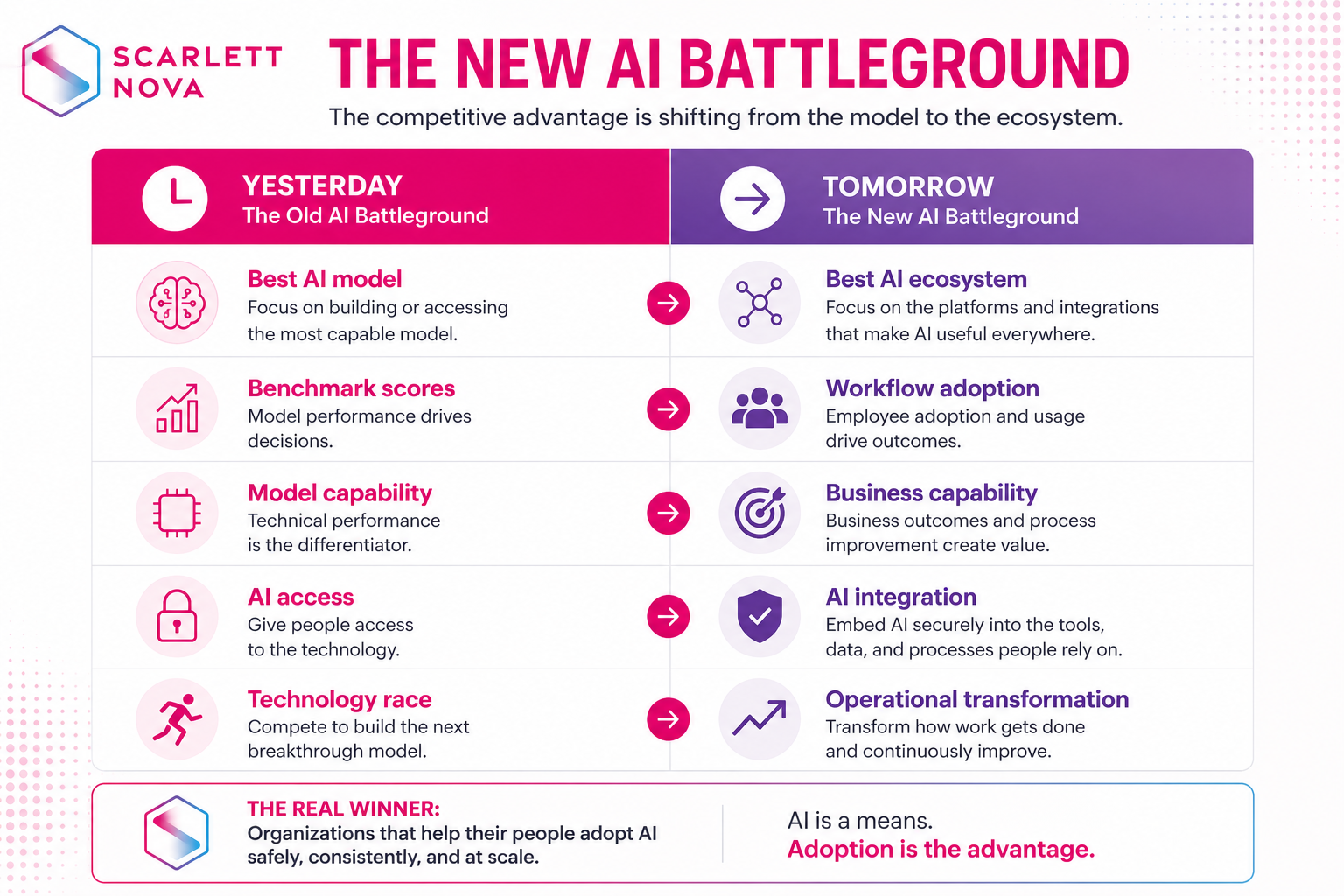
As powerful open-source models continue to emerge and new competitors close the performance gap with frontier AI labs, the competitive advantage is shifting. The organizations creating the most business value may not be the ones building the smartest models. They may be the ones making AI the easiest to adopt.
That is why Microsoft has become such a dominant enterprise AI player.
It is also why Google is becoming increasingly difficult to ignore.
Legacy is becoming Microsoft's biggest AI advantage
Microsoft didn't begin the AI race with the industry's most advanced language model.
What it had was something arguably more valuable.
Millions of organizations already rely on Outlook, Teams, Word, Excel, SharePoint, and Azure every day. AI didn't require employees to learn an entirely new platform. Copilot simply appeared inside the applications they were already using.
For most organizations, that dramatically lowers the barrier to adoption.
Instead of asking employees to switch tools, Microsoft brought AI into existing workflows.
That makes Copilot feel like the safer, enterprise-ready option, even when competing models may outperform it on specific benchmarks.
Google is pursuing the same strategy
Google Workspace is following a remarkably similar path.
Gemini is now embedded throughout Gmail, Docs, Sheets, Meet, Drive, Calendar, and other Workspace applications.
Rather than asking organizations to adopt another AI platform, Google is weaving AI into the collaboration tools millions of knowledge workers already use every day.
The strategy mirrors Microsoft's.
The value isn't simply the model.
The value is that AI becomes part of how work already happens.
The model advantage may not last
The arrival of increasingly capable open-source models has accelerated another trend.
Model performance is becoming easier to replicate.
Organizations can now choose from an expanding list of high-performing proprietary and open-source models depending on their requirements for privacy, cost, speed, and governance.
As models become more interchangeable, competitive differentiation shifts elsewhere.
It shifts toward:
- Workflow integration
- Security and governance
- Identity and permissions
- Employee adoption
- Business process redesign
- Change management
In other words, the operating model becomes more valuable than the model itself.
Adoption is becoming the real competitive advantage
Too many organizations are still evaluating AI by comparing model benchmarks.
Employees rarely choose technology because it scores higher on an evaluation leaderboard.
They choose technology because it helps them complete work with less friction.
The organizations seeing the greatest return from AI are often those that remove obstacles to adoption.
That means AI appears where employees already work, respects existing governance, and supports established business processes.
The question shifts from:
"Which model should we buy?"
to
"How quickly can our people adopt AI responsibly inside their daily work?"
That is a very different leadership conversation.
What leaders should focus on now
Instead of asking which AI model is smartest, executive teams should ask:
- Which platforms are already central to our employees' daily work?
- Where can AI reduce friction without creating new complexity?
- Do we have governance that enables responsible adoption instead of slowing it?
- Are we measuring business outcomes or simply counting AI usage?
These questions matter far more than the latest benchmark results.
ScarlettNova's Perspective
The AI market is entering a new phase.
The race is no longer only about building larger or more capable models.
It is increasingly about helping organizations deploy AI safely, consistently, and at scale.
Microsoft and Google understand this because they own much of the workplace ecosystem.
For every other organization, the lesson is similar.
Competitive advantage won't come from having access to the same AI models as everyone else.
It will come from how effectively your organization integrates AI into everyday work, earns employee trust, and delivers measurable business outcomes.
That is the difference between experimenting with AI and adopting it.
ScarlettNova helps organizations move beyond AI experimentation by aligning strategy, governance, workflows, and people to create measurable business impact.