Before an AI agent touches your customer records, someone needs to decide what it is allowed to change.
Before it contacts a supplier, someone needs to define which commitments it can make.
And before it starts working independently, someone needs to know how to judge its performance and stop it when necessary.
These are business decisions. They belong at the beginning of an agentic AI initiative.
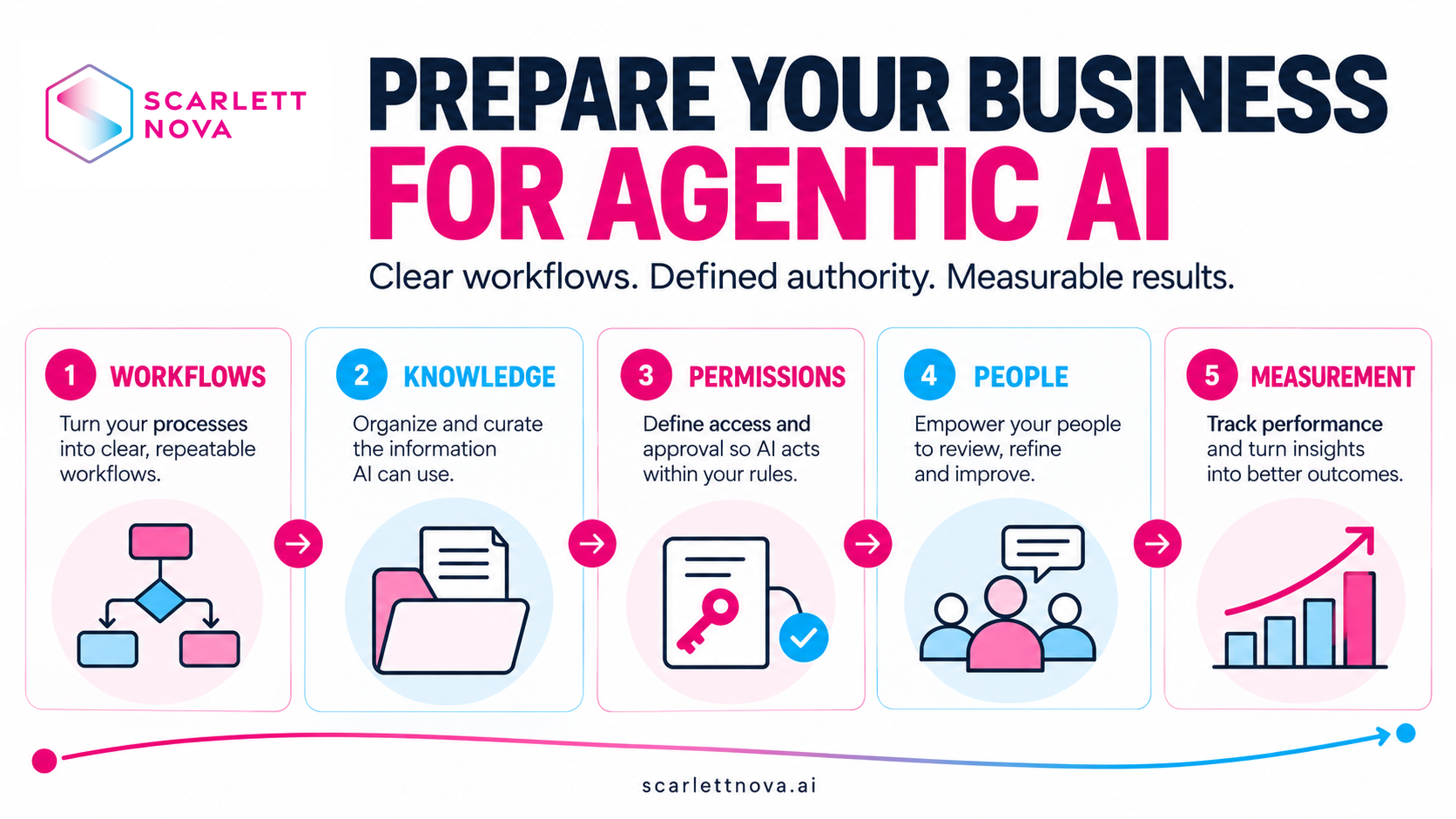
ScarlettNova’s recommendation is straightforward: prepare one workflow, its information, its permissions and its people before expanding autonomy.
The technology deserves experimentation. The preparation deserves equal attention.
1. Choose a workflow you can explain and evaluate
Agentic AI describes systems that can pursue a goal through multiple steps, selecting tools and adjusting their actions as they receive information. Anthropic distinguishes these agents from workflows that follow predefined paths. It also recommends starting with the simplest approach that solves the problem. Anthropic’s engineering guidance
That distinction matters when choosing your first use case.
If a task follows stable rules, conventional automation may be sufficient. If employees need help interpreting information, an assistant may be sufficient. An agent becomes more relevant when the work requires flexible decisions across several steps.
The direction of travel is clear. On September 25, Microsoft announced Copilot Autopilot, describing a persistent agent that can carry out recurring work. Its announcement said Autopilot would expand to private preview at the end of September. This is evidence of product direction, not proof that every organization can deploy it successfully today. Microsoft’s announcement
Start with a specific operational problem.
“Bring agents into customer service” is too broad.
“Prepare a response to routine order-status enquiries using approved order records and delivery policies” is something a team can define and test.
For that hypothetical pilot, document the trigger, required information, expected output, exceptions and accountable owner. Measure the current handling time and correction rate before introducing AI.
Choose work with enough repetition to evaluate, a clear definition of success and consequences you can contain.
2. Prepare the knowledge the agent will depend on
An experienced employee may know that an old pricing spreadsheet is unreliable or that a particular customer has an exception to the standard policy. An agent needs a dependable way to identify that context.
For the selected workflow, establish which information is authoritative.
Identify the current policy, the approved templates, the relevant system of record and the person responsible for keeping each source current. Remove obsolete documents from the agent’s accessible collection, or label them clearly.
Define what happens when sources disagree. A conflict should trigger a defined response, such as requesting clarification or escalating to the owner.
You do not need to clean up every document in the company before starting. Prepare the information required for one bounded use case.
In the order-status example, the agent might need order records, delivery information and approved response guidance. It probably does not need access to the entire customer file repository.
Build a small test collection containing normal requests, incomplete records, conflicting information and cases that should be escalated. Include examples of an acceptable response and an unacceptable one.
This gives the team a shared standard for evaluation before a persuasive demonstration starts shaping expectations.
3. Define authority before connecting tools
Reading information, drafting a recommendation and taking action require different levels of authority.
Treat them as separate decisions.
For each proposed agent, specify:
- What it may read.
- What it may prepare.
- What it may change without approval.
- What requires a named person’s approval.
- What it must never do.
In the hypothetical customer-service pilot, the agent could retrieve order information and draft a response. Sending the message could require approval. Refunds, account changes and delivery guarantees could remain outside its scope.
Enforce these boundaries through system permissions and approval controls. Written instructions alone should not carry the entire burden.
NIST’s AI Agent Standards Initiative includes work on agent identity, authentication and security evaluations. OWASP’s agentic security guidance identifies risks including tool misuse, privilege abuse and malicious instructions that redirect an agent’s goal. NIST initiative · OWASP guidance
Our practical recommendation is to give the agent the minimum access required, record consequential actions and establish a tested way to revoke access.
Test what happens when an email or document tells the agent to ignore its rules. Test unavailable systems and repeated requests. Confirm that a retry cannot accidentally send the same message or initiate the same action twice.
Permissions are part of the workflow’s design.
4. Train people to supervise delegated work
Agentic AI changes what employees need to know.
They still need to give clear instructions. They also need to inspect proposed actions, recognize missing context, handle exceptions and know when to intervene.
Training should use the actual workflow.
Give employees a correct result, a plausible but incorrect result, and a case the agent should refuse or escalate. Ask them to identify the difference and explain what they would do next.
Make approval meaningful. A reviewer should be able to see the proposed action, the supporting information and the consequences before authorizing it.
Also assign responsibility for the system after launch. Someone must maintain the knowledge sources, review failures, approve changes and support employees when the workflow breaks.
For a smaller company, several responsibilities may sit with the same person. They should still be explicit.
Invite the people doing the work to help design the pilot. They can identify exceptions that a process diagram misses and point out where a proposed improvement simply shifts effort onto someone else.
Give them time to practise and a straightforward way to report problems. Useful feedback should improve the system, not become evidence that employees are resisting change.
5. Let evidence determine how much autonomy comes next
A successful demonstration is a starting point for testing.
Begin in a test environment or in shadow mode, where the agent produces proposed results without changing live records or contacting customers. Compare its work with the existing process.
Then consider a limited live pilot with defined approval points.
Before expanding, assess:
- Quality: How often is the result correct and complete?
- Exceptions: Does the agent recognize when it needs help?
- Oversight: How much review and correction does it require?
- Economics: What does a successfully completed case cost, including human effort?
- Control: Can the team detect problems, stop further actions and recover?
Set acceptance criteria before reviewing the results. An average success rate should not conceal a serious failure, such as exposing information to the wrong customer.
For a manageable first-month preparation sprint, use the first week to select and baseline the workflow. Use the second to prepare information and permissions. Use the third to train reviewers and test difficult cases. Use the fourth to decide whether the evidence supports a limited live pilot.
This is a planning example, not a universal deployment timetable. More consequential workflows may require substantially more preparation.
Expand one boundary at a time. Adding a new system, granting permission to send messages or allowing financial actions should each trigger a fresh review.
The objective is useful work completed reliably, with an acceptable level of oversight and cost.
Companies can begin preparing now, even while platforms continue to change. Clear workflows, dependable knowledge, defined authority and capable people will remain valuable across tools.
At ScarlettNova, we believe agentic AI should earn greater responsibility through demonstrated performance. That gives organizations a practical way to move forward, learn quickly and build confidence.
ScarlettNova helps organizations prepare for and implement AI through workflow assessment, governance, integration, training and measurement. To discuss a practical starting point, contact chris@scarlettnova.ai or hello@scarlettnova.ai, or visit www.scarlettnova.ai.