Organizations are investing in artificial intelligence with the expectation that it will improve productivity, reduce costs, accelerate decisions, and create new opportunities.
But providing employees with AI tools does not mean an organization is ready to use them.
A recent edX Enterprise study, released October 8, 2026, found that 83% of surveyed workforce and learning leaders consider AI capabilities a priority, yet only 29% report having mature AI capabilities within their organizations.
The gap points to a fundamental leadership challenge.
Organizations are often moving faster to acquire AI technology than to establish the conditions required to use it successfully.
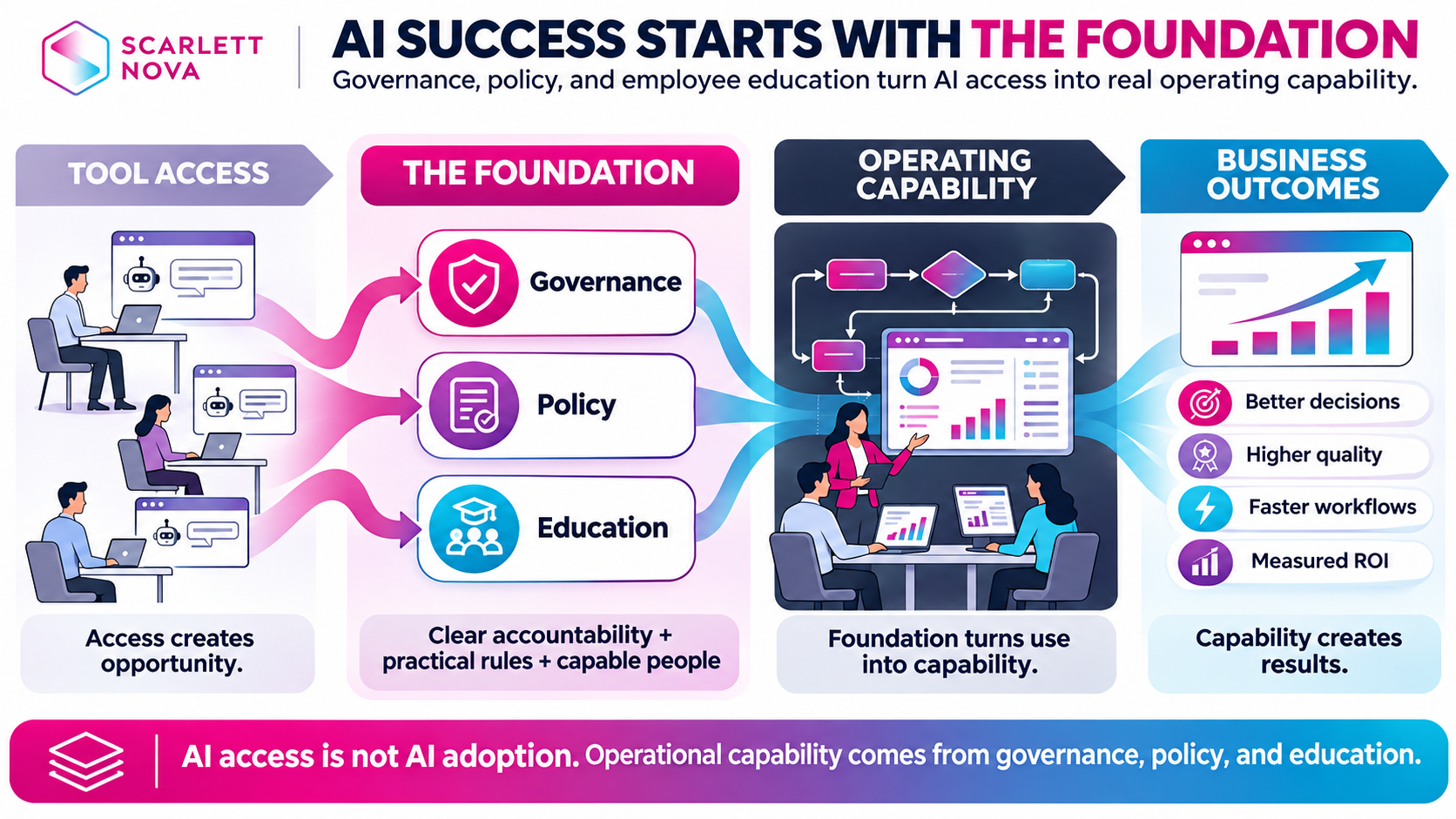
At ScarlettNova, we believe sustainable AI success begins with three foundational elements: governance, policy, and education.
Governance establishes accountability. Policy provides clear operating boundaries. Education gives employees the knowledge and confidence to work effectively within those boundaries.
Without this foundation, AI adoption risks becoming a collection of disconnected experiments rather than a coordinated business capability.
AI Adoption Is Not the Same as AI Readiness
An organization can have AI licences, enthusiastic employees, executive sponsorship, and several active pilots while remaining poorly prepared for meaningful adoption.
Consider a common scenario.
The marketing team uses AI to create content. Human resources experiments with AI-assisted job descriptions. Finance explores document analysis. Operations uses AI to summarize reports and identify process improvements.
Each team may be discovering value.
But important questions remain unanswered.
Who decides which tools employees can use? What information can be entered into those tools? Who is responsible for verifying AI-generated work? How are employees trained? How does leadership determine whether AI is improving business performance?
Without consistent answers, every department develops its own approach to risk, quality, and acceptable use.
The organization may have widespread AI activity without coordinated AI adoption.
This distinction is becoming more important as AI moves beyond generating content and begins influencing decisions, accessing business systems, and supporting more complex workflows.
Research published by Wharton Human-AI Research in October 2026 reinforces the importance of organizational alignment. Its AI adoption report identifies proving business value, transforming workflows, and aligning organizations as central characteristics of successful AI transformation.
The lesson for leaders is straightforward.
AI readiness must be built deliberately. It does not automatically arrive when the technology is deployed.
Governance: Establish Accountability Before Scaling Capability
Governance is often misunderstood as an exercise in restricting technology.
Effective AI governance does something more valuable. It establishes how the organization makes decisions about AI, who owns those decisions, and how responsible use is maintained as adoption expands.
Governance should answer fundamental questions:
- Who is accountable for AI strategy and adoption?
- Who approves new use cases and evaluates their risks?
- Who is responsible when AI produces an incorrect or inappropriate outcome?
- How are privacy, security, accuracy, and compliance concerns assessed?
- How does leadership monitor performance and respond when problems emerge?
These questions are not exclusively the responsibility of IT.
AI affects operational processes, employee responsibilities, customer interactions, and organizational risk. Governance therefore requires participation from business leadership, operations, people leaders, technology, and relevant risk functions.
For smaller organizations, this does not require a large governance committee or a new executive department.
It may mean identifying one accountable leader, bringing together a small cross-functional working group, establishing an approval process, and reviewing AI adoption regularly.
The objective is proportionate governance.
A low-risk internal brainstorming application should not face the same requirements as an AI system influencing employee selection, handling sensitive client information, or making financial recommendations.
Recent research supports treating governance as an enabler rather than an obstacle. An October 26, 2026 BCG analysis found stronger reported AI returns among companies combining innovation with accountability and governance.
This finding does not mean governance alone produces better returns. It does suggest that organizations should not treat governance and innovation as competing priorities.
Good governance creates the confidence to innovate responsibly.
Policy: Replace Uncertainty With Practical Direction
Governance determines who is responsible.
Policy explains what people can and cannot do.
Yet many organizations approach AI policy from one of two extremes.
Some have no meaningful guidance, leaving employees to make their own decisions about tools, information, and appropriate use.
Others develop highly restrictive policies that describe everything that could go wrong without giving employees a practical way to work with AI.
Neither approach creates the conditions for confident adoption.
An effective AI policy should be accessible, understandable, and connected to real work.
Employees need clear answers about approved tools, acceptable information, human review, intellectual property, confidentiality, and when they must escalate a concern.
For example, an employee preparing a client presentation should understand whether they can use AI to structure the content, what client information must remain outside the tool, and who must verify the final material.
A finance employee should know whether AI can assist with financial analysis and what level of human review is required before the analysis informs a decision.
A customer service employee should understand whether AI-generated responses may be sent directly or require approval.
These are practical operating questions, not abstract technology principles.
An effective policy also needs to evolve.
AI tools and organizational use cases will change. Policies that are never revisited can quickly become disconnected from actual working practices.
A manageable approach is to create a clear baseline policy, communicate it across the organization, and establish a regular review cycle informed by employee experience and emerging risks.
Canada's federal AI strategy similarly identifies governance, policy, and talent development as essential priorities for responsible AI adoption.
The important principle is that policy should enable responsible action, not simply document restrictions.
Education: The Missing Link Between AI Access and Real Adoption
Even the strongest governance framework and clearest policy cannot produce meaningful AI adoption if employees do not understand the technology.
This is where organizations frequently underestimate the investment required.
Providing a tool and offering a brief demonstration is not the same as building organizational capability.
Employees need to understand what AI can do, where its limitations lie, how to evaluate its outputs, and how it applies to their responsibilities.
Effective AI education should develop three capabilities.
First, AI literacy. Employees need a practical understanding of how generative AI works, why it sometimes produces inaccurate information, and what risks arise from sharing sensitive data.
Second, responsible application. Employees need to understand the organization's policies, their own accountability, and the circumstances in which human verification is essential.
Third, role-specific capability. People need opportunities to apply AI to familiar workflows, practise using it effectively, and evaluate whether the resulting work is genuinely better.
An HR professional and a financial analyst may use the same AI platform, but their responsibilities, information sensitivity, and training needs will differ.
Education should reflect those differences.
Training also needs to go beyond a one-time session.
Employees benefit from approved examples, supervised practice, peer learning, accessible support, and continued opportunities to develop their skills.
Managers have a critical role. They must understand enough about AI to recognize useful applications, assess risks, reinforce policies, and lead changes to how their teams work.
The objective is not to turn every employee into an AI specialist.
It is to build a workforce capable of using AI with confidence, sound judgment, and a clear understanding of its responsibilities.
An organization that invests only in AI technology is buying access.
An organization that invests in employee education is developing capability.
The Three Foundations Must Work Together
Governance, policy, and education should not be treated as independent initiatives.
They reinforce one another.
Governance without policy can leave employees uncertain about acceptable use.
Policy without education can become a document employees acknowledge but do not understand or consistently apply.
Education without governance and policy can encourage experimentation without appropriate oversight.
The strongest foundation emerges when all three operate as a connected system.
Governance establishes ownership and accountability. Policy translates those decisions into practical expectations. Education enables people to put those expectations into practice.
Experience from employees then informs improvements to the policies and governance framework.
This creates an ongoing cycle of learning, oversight, and operational improvement.
It also creates a stronger basis for measuring value.
Rather than celebrating the number of AI licences activated or employees trained, leaders can evaluate whether AI is improving process quality, reducing avoidable rework, shortening service delivery times, improving accuracy, or creating additional organizational capacity.
The difference matters.
Activity demonstrates that AI is being used.
Business outcomes demonstrate whether AI adoption is working.
Five Actions Leaders Can Take in the Next 90 Days
Building an AI foundation does not require delaying every AI initiative until a complex governance structure is complete.
It requires establishing the right fundamentals and improving them as the organization learns.
1. Assign clear accountability for AI.
Identify an executive sponsor and an operational owner responsible for coordinating governance, policy, education, and adoption. Ensure the appropriate business functions participate in decisions.
2. Establish a practical AI acceptable-use policy.
Clearly define approved tools, information-handling requirements, acceptable uses, human-review expectations, and escalation procedures. Make the guidance easy for employees to find and apply.
3. Assess employee AI knowledge and confidence.
Determine what employees understand, where uncertainty exists, and what different roles require. Use that assessment to prioritize meaningful education rather than providing identical training to everyone.
4. Connect education to actual workflows.
Select a small number of low-risk, high-value business activities where employees can apply AI using approved tools and established safeguards. Provide guided practice and collect feedback.
5. Measure operational outcomes and improve the foundation.
Establish baseline measures such as accuracy, cycle time, service quality, rework, or cost per completed outcome. Review results, identify policy gaps, and adjust training before expanding adoption.
These steps create a manageable path from isolated experimentation to more disciplined organizational adoption.
AI Success Is Built Before It Is Scaled
The competitive advantage of AI will not come simply from providing access to the latest tools.
Access is becoming easier to obtain.
What remains difficult is building an organization that knows how to use those tools responsibly, consistently, and productively.
That requires leadership discipline, clear accountability, practical operating rules, and employees who understand both the opportunities and limitations of AI.
For Canadian businesses, associations, non-profits, and public-sector organizations, the foundation does not need to be complicated. It needs to be intentional, proportionate, and connected to the work people perform.
Organizations that establish this foundation will be better positioned to evaluate opportunities, manage risks, build employee confidence, and scale what produces measurable results.
Those that skip it may find themselves investing in increasingly powerful AI tools without developing the organizational capability needed to realize their value.
The future of AI success will not be determined by who adopts the most technology. It will be determined by who builds the strongest capability to use it.
How ScarlettNova Can Help
ScarlettNova helps organizations establish practical AI governance, develop clear policies, and build employee capability so AI can move from experimentation into responsible, measurable operational adoption.
Build the foundation. Enable your people. Turn AI into business impact.