Your business does not need to be advanced in AI to get meaningful results.
It needs to know where it stands and what to do next.
Some organizations are just beginning to explore AI tools. Others have employees using AI regularly but struggle to translate that activity into business improvements. A smaller group has integrated AI into workflows, established governance, and begun scaling what works.
These businesses should not be following the same roadmap.
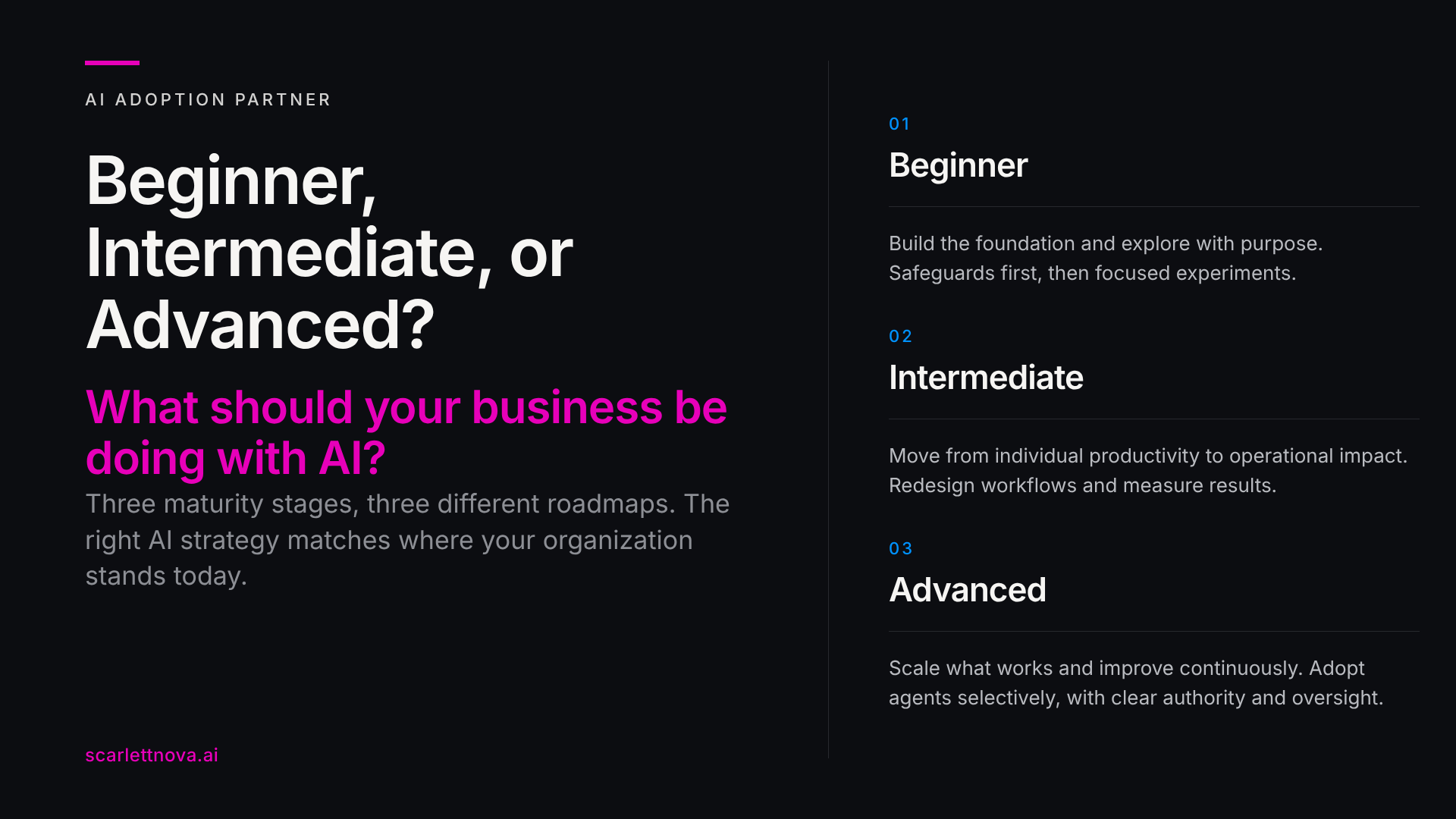
A beginner organization needs foundational knowledge, clear safeguards, and focused experimentation. An intermediate organization needs process integration, accountability, and measurable results. An advanced organization needs consistent execution, optimization, and the ability to adapt.
The right AI strategy is not the most sophisticated one. It is the one that matches your organization’s maturity and moves the business forward.
AI maturity is about capability, not how many tools you use
AI maturity is often mistaken for technology sophistication.
A company using AI agents, custom applications, or multiple enterprise platforms may appear advanced. But if employees lack training, processes are poorly defined, or nobody measures results, the organization may still be relatively immature in its adoption practices.
Conversely, a small business using a handful of approved AI tools may have strong governance, well-trained employees, repeatable workflows, and clear evidence of business value.
That organization may be more mature than its technology suggests.
Canada’s SME AI Adoption Blueprint recognizes that businesses differ in the depth and breadth of their AI adoption. It also emphasizes that AI adoption is not necessarily a linear journey.
Wharton’s October 2026 AI Adoption Report highlights the importance of proving value, transforming workflows, and aligning organizations.
These ideas point toward a practical conclusion: AI maturity should be evaluated across the business, not just within the technology department.
For leadership teams, three levels provide a useful starting point.
Beginner: Build the foundation and explore with purpose
Where your business is today
AI use is limited, informal, or inconsistent.
Some employees may be experimenting with ChatGPT, Copilot, or other tools, while others have little experience. Leadership is interested in AI but has not established a clear strategy.
There may be uncertainty about which tools are appropriate, what information employees can share, and where AI could deliver meaningful value.
The biggest risk at this stage is allowing enthusiasm or uncertainty to determine the direction of adoption.
What your business should be doing
The beginner stage is about establishing the conditions for responsible experimentation.
Start with business problems, not technology.
Identify repetitive administrative activities, information-heavy tasks, or processes where employees spend considerable time preparing, searching, summarizing, or organizing information.
Then determine whether AI could help.
At the same time, introduce foundational AI literacy. Employees should understand what AI can and cannot reliably do, how to evaluate its output, and how to protect sensitive information.
A basic acceptable-use policy should establish approved tools, information-handling requirements, human verification expectations, and activities that require additional approval.
Governance should begin here, not after the organization has already deployed AI widely.
Five priorities for beginner businesses
- Identify three practical opportunities. Focus on business problems where AI could reduce effort, improve consistency, or support better decisions.
- Build foundational AI literacy. Train employees and managers on appropriate use, limitations, verification, and data protection.
- Establish basic AI governance. Define approved tools, acceptable use, confidentiality expectations, and accountability.
- Run small, controlled experiments. Choose low-risk activities and document what works, what fails, and what employees learn.
- Create an initial adoption roadmap. Identify which experiments warrant further investigation and who will be responsible.
What success looks like
Success at the beginner stage is not widespread automation.
It is an organization that understands AI’s practical possibilities, has basic safeguards in place, and can identify a few credible opportunities for business improvement.
When to move forward: Leadership has identified priority opportunities, employees understand the rules, and at least one experiment has shown enough promise to justify a measured pilot.
Intermediate: Move from individual productivity to operational impact
Where your business is today
Employees are using AI regularly.
Some teams have developed effective practices, and individual productivity improvements may be visible.
However, adoption is uneven. Different departments may use different tools, training is inconsistent, and AI often remains separate from established business processes.
Employees may produce reports, proposals, or communications faster, but the organization cannot clearly demonstrate whether overall performance has improved.
This is where many businesses encounter the gap between AI usage and AI adoption.
What your business should be doing
The intermediate stage is about moving from experimentation to repeatable business results.
Start by selecting a few high-value workflows.
Rather than asking how AI can help an employee complete a task, examine how the entire process works.
For example, an AI tool might reduce the time required to draft a customer response. But if the response requires extensive correction, manual transfer between systems, or additional approvals, the overall process may not improve.
Map the workflow from beginning to end.
Identify where AI should assist, where existing automation could remove unnecessary steps, and where human judgment remains essential.
Assign a business owner who is accountable for the outcome.
Training should become role-specific. Employees need to understand how AI fits into their responsibilities, what they must verify, and when to escalate an issue.
Governance also needs to mature. The organization should introduce consistent risk assessments, vendor review practices, documented procedures, and performance monitoring proportionate to the use case.
Five priorities for intermediate businesses
- Prioritize proven use cases. Select workflows with clear business value, manageable risk, and realistic implementation requirements.
- Redesign workflows around AI. Improve the process rather than simply adding AI to existing steps.
- Introduce role-specific training. Equip employees to use AI consistently within their actual responsibilities.
- Formalize operational governance. Establish business ownership, review standards, access controls, and escalation procedures.
- Measure end-to-end results. Track cycle time, quality, cost, rework, employee experience, and business outcomes.
What success looks like
AI is no longer an optional productivity tool used differently by each employee.
It becomes part of selected business processes, with documented procedures, trained employees, clear ownership, and measurable improvements.
When to move forward: Several AI-enabled workflows consistently deliver value, employees can operate them reliably, and the organization has the management capability to support broader deployment.
Advanced: Scale what works and continuously improve
Where your business is today
AI has become an established part of operations.
Multiple teams use approved AI capabilities within defined workflows. Leadership understands the value being generated and has processes for managing risks, supporting employees, and monitoring performance.
The organization may be exploring more sophisticated automation, AI agents, predictive systems, or integrations between business platforms.
But advanced maturity is not defined by adopting these technologies.
It is defined by the organization’s ability to deploy and manage AI reliably at scale.
What your business should be doing
The advanced stage is about sustained performance and continuous improvement.
Organizations should establish a consistent operating model for evaluating, implementing, monitoring, and improving AI-enabled processes.
This includes common governance standards, reusable implementation practices, performance reporting, incident management, and clear accountability.
AI initiatives should be evaluated as part of the broader business investment portfolio.
Leaders should ask whether an initiative improves service delivery, reduces operating costs, increases capacity, improves decision quality, or creates new opportunities.
Advanced automation should be introduced selectively.
For example, an AI agent that can update customer records or initiate business transactions requires clearly defined authority, controlled access, monitoring, and escalation rules.
The more consequential the action, the stronger the need for appropriate oversight.
Workforce development also remains essential.
As AI changes how work is performed, organizations need to update responsibilities, develop new skills, and ensure employees understand where their judgment adds value.
Five priorities for advanced businesses
- Scale proven workflows systematically. Expand successful capabilities using consistent standards, support, and governance.
- Optimize business performance. Continuously improve quality, reliability, cost, and customer outcomes.
- Strengthen monitoring and accountability. Track system performance, risks, incidents, vendor dependencies, and changing business requirements.
- Develop the workforce for AI-enabled operations. Update roles, management practices, and professional development.
- Explore advanced capabilities selectively. Invest in agents, predictive applications, or more sophisticated automation where they offer measurable business value.
What success looks like
AI is managed as an ongoing business capability.
The organization can identify opportunities, implement solutions, manage risks, train employees, measure results, and improve performance without repeatedly starting from scratch.
The objective: Sustainable operational advantage, not technological complexity for its own sake.
Your business may be at different maturity levels at the same time
One of the most important considerations is that AI maturity is rarely uniform.
A marketing team may have integrated AI into content production and campaign analysis, while finance is still experimenting with reporting tools.
An operations department may have mature automation practices, while human resources is only beginning to establish appropriate use cases.
That is normal.
Organizations should not force every department to progress at the same speed.
Instead, evaluate maturity across five dimensions:
- Strategy: Are AI investments connected to business priorities?
- People: Do employees have the skills and support to use AI effectively?
- Processes: Is AI integrated into repeatable workflows?
- Governance: Are risks, responsibilities, and controls clearly managed?
- Technology: Are tools, data, and integrations reliable and appropriate?
A business might be intermediate overall but beginner in governance.
That gap matters more than the average maturity label.
The purpose of assessment is to identify the capabilities that need attention before the organization makes its next investment.
What should your business do in the next 90 days?
Regardless of maturity, every organization can take four practical steps.
First, establish your baseline. Assess your current capabilities across strategy, people, processes, governance, and technology.
Second, identify your most important gap. Determine what is preventing the next meaningful improvement. It might be employee knowledge, unclear priorities, poor data, workflow design, or insufficient governance.
Third, select a manageable set of actions. Choose two or three initiatives appropriate to your maturity level. Assign owners, resources, and deadlines.
Fourth, define the evidence of success. Establish what must improve and how the organization will know whether the investment worked.
For beginners, success might mean safe experimentation and validated opportunities.
For intermediate organizations, it might mean reduced process cycle time or improved service quality.
For advanced organizations, it might mean sustained performance across multiple business functions.
The measures change as maturity develops, but the discipline of measurement should remain constant.
The goal is not to become advanced. It is to become effective.
AI maturity is not a competition.
A beginner organization that establishes strong foundations and identifies one valuable use case is making meaningful progress.
An intermediate organization that redesigns a workflow and demonstrates measurable improvement may be creating more value than a company deploying sophisticated technology without clear accountability.
An advanced organization that continually improves its operating model is building capabilities that can adapt as technology and business conditions change.
The common thread is deliberate adoption.
At ScarlettNova, we believe AI should be treated as a business capability, not a technology destination.
The right priorities depend on your current maturity, your organizational constraints, and the outcomes you are trying to achieve.
You do not need to be advanced in AI. You need to be effective at your current stage and intentional about the next one.
ScarlettNova helps organizations assess their AI maturity and build practical adoption roadmaps that connect strategy, governance, people, and technology to measurable business outcomes. Whether your organization is beginning, integrating, or scaling AI, the right next step starts with understanding where you are today.