For the past several years, businesses have been asking the same question: How do we get our employees to adopt AI?
That is no longer enough.
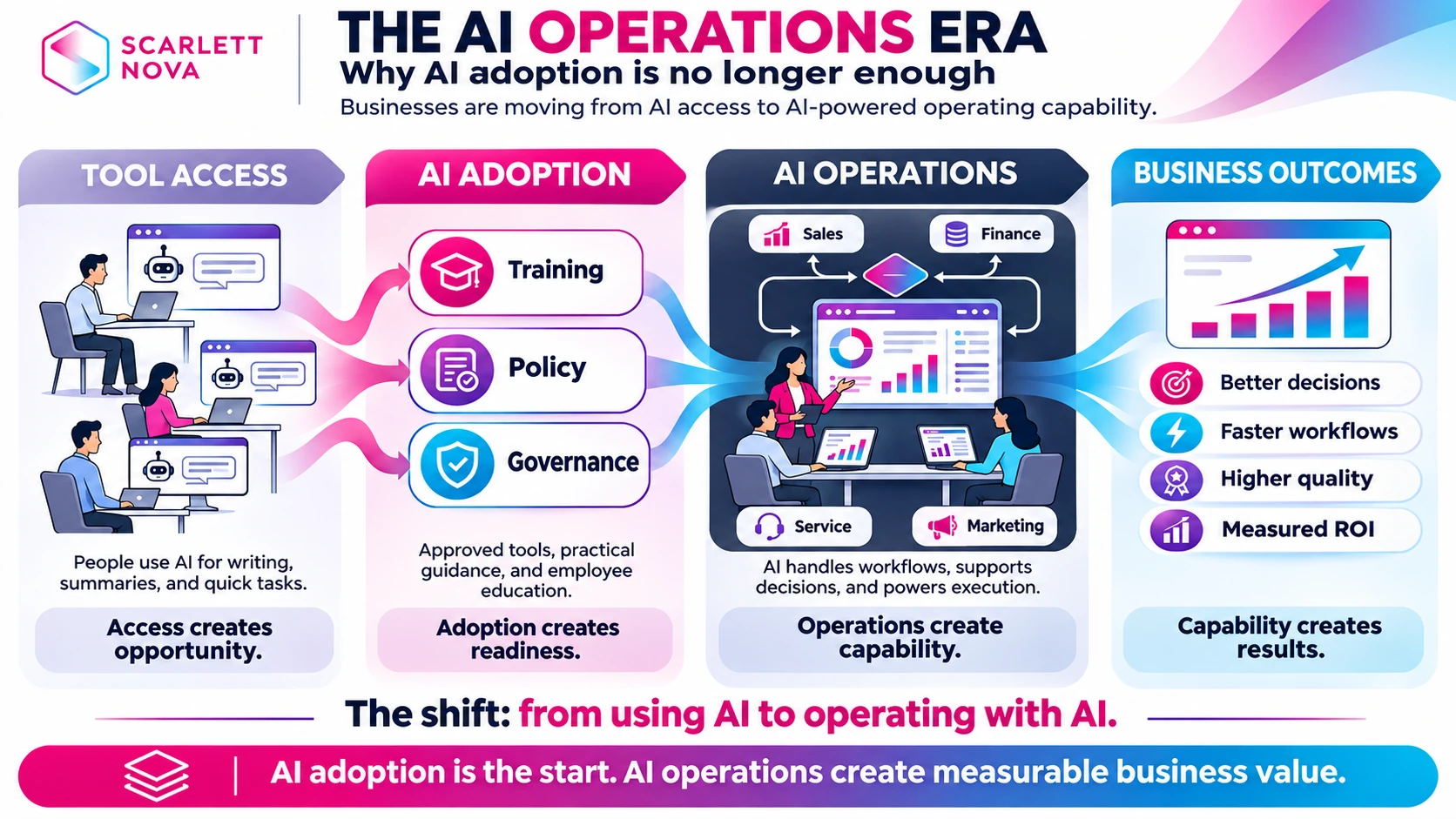
The next stage of artificial intelligence is not simply about employees using AI. It is about AI becoming an operational layer within an organization, executing workflows, connecting business systems, managing information and making decisions within established boundaries.
We are moving from AI adoption to AI operations.
From Conversations to Execution
The first wave of generative AI was largely conversational. Employees used AI to write emails, summarize documents, conduct research, brainstorm ideas and analyze information.
These applications delivered productivity improvements, but they rarely fundamentally changed how organizations operated.
That is changing.
AI platforms are increasingly capable of completing delegated assignments, interacting with enterprise applications, executing multi-step workflows and operating with varying degrees of autonomy.
Recent developments across Microsoft, Salesforce and Anthropic demonstrate the direction the industry is taking. AI is becoming more deeply integrated into the systems businesses already use, reducing the separation between intelligence and execution.
Instead of asking AI how to complete a task, employees can increasingly delegate the task itself.
The Traditional Software Interface Is Being Disrupted
For decades, employees have been trained to navigate software.
They open applications, search through databases, populate fields, generate reports and manually transfer information between platforms.
AI challenges that entire operating model.
Imagine a sales manager who no longer needs to navigate a CRM, spreadsheets and reporting dashboards. Instead, they ask an AI agent to evaluate the sales pipeline, identify at-risk opportunities, recommend follow-up actions and prepare personalized communications.
The underlying software still exists, but the way employees interact with it fundamentally changes.
The software becomes the infrastructure. AI becomes the interface.
This has significant implications for CRM platforms, enterprise resource planning systems, business intelligence tools and virtually every category of business software.
AI Adoption Is Becoming a Financial Conversation
Until recently, many organizations measured AI adoption through relatively basic metrics:
- Number of employees using AI.
- Number of AI licences purchased.
- Number of employees trained.
- Frequency of AI usage.
- Estimated hours saved.
These metrics are useful, but they do not necessarily demonstrate business value.
Organizations must increasingly answer more meaningful questions.
Has AI increased revenue? Reduced operational costs? Improved customer retention? Increased organizational capacity? Reduced processing times?
AI investments need to be evaluated against business outcomes, not simply usage statistics.
The organizations that successfully operationalize AI will establish performance benchmarks before implementation and continuously measure the financial and operational impact of their AI initiatives.
The Rise of the Hybrid Workforce
Organizations are beginning to operate with a combination of human employees, AI assistants, specialized agents and automated workflows.
Consider what this could look like across an organization.
| Department | Emerging AI operational capabilities |
|---|---|
| Sales | Prospect identification, lead qualification and proposal development |
| Marketing | Campaign execution, market intelligence and performance analysis |
| Finance | Reconciliation, forecasting and anomaly detection |
| Human Resources | Onboarding, internal knowledge management and workforce planning |
| Customer Service | Inquiry resolution, service coordination and customer retention |
| Operations | Workflow execution, process monitoring and exception management |
| Leadership | Business intelligence, strategic analysis and decision support |
The opportunity is not necessarily to replace entire positions. It is to redesign how work is distributed between people and intelligent systems.
Employees become responsible for judgment, relationships, creativity, strategy and oversight, while AI increasingly handles structured, repetitive and information-intensive activities.
Organizational capacity becomes less directly tied to headcount.
Governance Becomes Operational Infrastructure
As AI moves from providing recommendations to executing actions, the consequences of inadequate governance become significantly greater.
Organizations must determine:
- What information AI agents can access.
- Which decisions AI can make independently.
- Which actions require human approval.
- How AI-generated work is reviewed.
- Who is accountable when something goes wrong.
- How agent performance, security and compliance are monitored.
An acceptable-use policy alone is no longer sufficient.
Organizations need operational governance frameworks that establish permissions, accountability, approval thresholds, monitoring requirements and escalation procedures.
Governance should not be viewed as an obstacle to innovation. It is the infrastructure that enables organizations to deploy AI with greater confidence.
The Biggest Barrier Is No Longer the Technology
AI technology is advancing faster than most organizations can adapt.
The primary barriers to successful implementation are increasingly organizational:
Fragmented data. Inefficient processes. Legacy systems. Unclear accountability. Leadership resistance. Insufficient training. Poorly defined business objectives.
Implementing AI into a broken process does not automatically fix that process. In some cases, it simply accelerates the inefficiency.
Organizations must understand how they operate before determining how AI should operate within them.
This requires business process analysis, technology integration, data readiness, change management and strategic leadership.
AI implementation is becoming a business transformation discipline rather than simply a technology project.
The Five Stages of AI Operational Maturity
At ScarlettNova, we see the evolution of organizational AI adoption through five stages.
| Stage | Description |
|---|---|
| 1. Exploration | Employees experiment with general-purpose AI tools. |
| 2. Enablement | Organizations establish policies, provide training and introduce approved platforms. |
| 3. Integration | AI connects with organizational data, applications and business processes. |
| 4. Execution | Specialized agents and automated workflows perform delegated business activities. |
| 5. Orchestration | Human employees and AI systems operate within a coordinated, measurable and governed business environment. |
Organizations do not need to reach full autonomy to generate significant value. However, remaining indefinitely at the experimentation stage will increasingly create a competitive disadvantage.
Unsure which stage your organization is in? The AI Readiness Score takes about 10 minutes and shows you where you stand today, and what to do next.
What Business Leaders Should Do Now
Leadership teams should begin shifting their AI strategies from employee adoption toward organizational transformation.
Start by identifying business processes that consume significant time, create operational bottlenecks or limit revenue growth.
Evaluate whether those processes can be redesigned using AI, rather than simply adding AI to existing workflows.
Establish measurable business outcomes, implement appropriate governance controls and develop the internal capabilities necessary to manage an increasingly intelligent operating environment.
Most importantly, recognize that AI transformation is not a one-time implementation project.
It is an ongoing organizational capability.
The Competitive Advantage Has Changed
Access to artificial intelligence is becoming increasingly democratized. Most organizations can purchase access to the same powerful models and platforms as their competitors.
Access alone is no longer a sustainable competitive advantage.
The advantage belongs to organizations that can integrate AI more effectively, redesign processes more intelligently, govern AI more responsibly and translate technological capabilities into measurable business outcomes.
The next generation of successful organizations will not simply be businesses that use AI.
They will be businesses designed to operate with AI.
The question business leaders should be asking is no longer:
“How do we get our employees to use AI?”
It is:
“How would we design our organization today if AI were already part of our workforce?”
The AI operations era has begun.
ScarlettNova helps organizations move beyond AI experimentation through strategic assessments, adoption roadmaps, governance, workforce enablement, intelligent automation and ongoing AI operational support.